
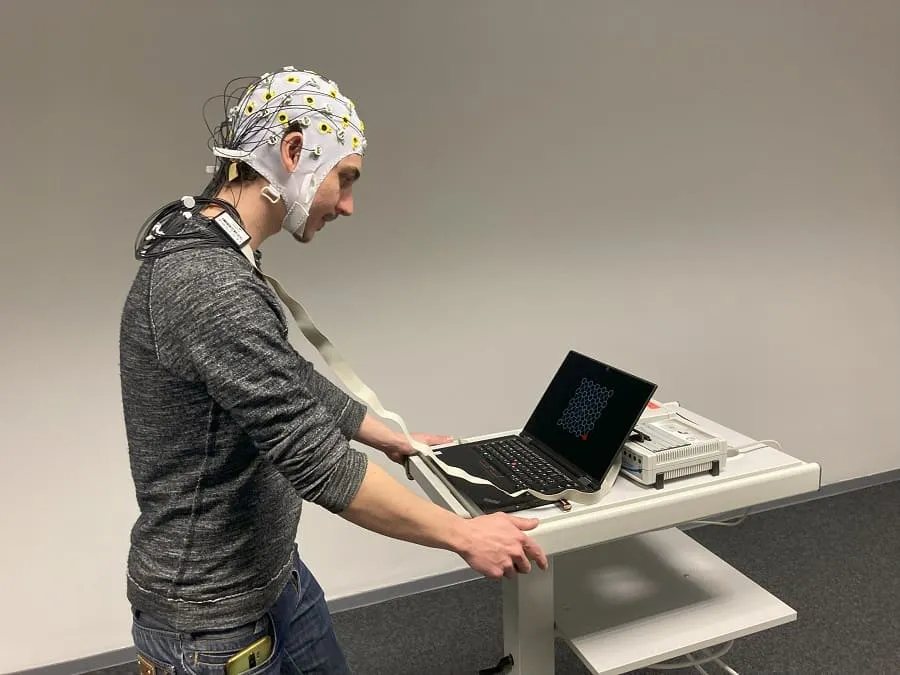
Movement artifacts pose a major challenge in EEG research as they introduce large amounts of noise into brain signal recordings, even for the smallest movements.
Collecting high quality data becomes particularly difficult in dynamic environments as the noise caused by these artifacts can distort the signals.
Therefore, understanding and characterizing these artefacts are essential steps in developing effective methods to isolate and remove them so that we can capture the most accurate and usable data possible.
Custom-made experiments: We recently investigated different mobility conditions during a cognitive task with auditory stimuli. The main experiment consisted of comparing a baseline condition in which participants were seated with a mobile condition in which participants walked back and forth between opposite sides of a room. In both conditions, the cognitive task remained the same: to identify a target sound in a series of non-target sounds.
In a separate condition, we also investigated how facial expressions and head movements appeared in the EEG sensors. These expressions and movements included eye, head, face and mouth movements.
Practical solutions: This experiment will allow us to characterize these artifacts in isolation, under carefully controlled conditions, and to develop methods that reduce their presence in EEG signals. This in turn will allow us to increase the robustness of decoding algorithms for passive brain-computer interfaces.
Real-world implications: This research is particularly important when it comes to implementing pBCI applications in everyday scenarios, where practicality and ease of use are important factors, and users can continue their daily activities with freedom of movement.
Iterative refinement: This research is important to further close the gap between controlled laboratory conditions and everyday real-life applications. Through constant experimentation and refinement, we are constantly improving our methods to account for the complexity of real-life situations and ensure that our strategies remain effective outside the lab.
In summary, by replicating natural movements in the lab and under controlled conditions, we gain deeper insights into movement related artifacts, that allow us to develop better strategies for dealing with artifacts to extract the most information from the data. pBCI applications that work seamlessly in everyday situations must be able to deal with real-life conditions, including movement artifacts.